Vespa velutina
Vespa velutina, sometimes known as the ‘Yellow-Legged (Asian) hornet’ is an invasive non-native species from Asia. If you find one you must report it. It arrived in France in 2004 and has spread rapidly. As a highly effective predator of insects, including honey bees and other beneficial species, it can cause significant losses to bee colonies, other native species and potentially ecosystems.
It is expected that the places it is most likely to be found in numbers are in southern parts of England (it may be able to cross the channel from France) or in goods among which it could be accidentally imported (such as soil with imported pot plants, cut flowers, fruit and timber). Active between April and November (peak August/September).
What to look out for
- Vespa velutina queens are up to 30 mm in length; workers up to 25 mm (slightly smaller than the native European hornet Vespa crabro)
- Mostly black body except for its 4th abdominal segment which is a yellow band located towards the rear
- It has characteristic yellow legs which accounts for why it is often called the yellow-legged hornet
- The face is orange with two brownish-red compound eyes
- Vespa velutina is a day-flying species which, unlike the European hornet, ceases activity at dusk
Identifying Yellow-Legged (Asian) Hornet
National Bee Unit identification poster
These resources can be ordered direct from the NBU office by contacting nbu@apha.gsi.gov.uk – but to save time and money you can also download the files above and print them yourselves
Report a sighting of the Yellow-Legged (Asian) Hornet
What do you do if you find a Yellow-Legged (Asian) Hornet?
1. Take a photograph, as this will be needed to enable identification, and if possible the exact location where seen, using something like What3Words
2. Please report the sighting using the Asian Hornet Watch app on your phone to send a picture and a location via GPS in the app straight to the non-native species secretariat and National Bee Unit.
Download on Google Play Download on the Apple App Store
3. If you cannot download the Hornet Watch app, please use this online recording form
4. As a last resort, you send a picture and email with details of where you saw the Yellow-Legged (Asian) hornet with your contact details
to alertnonnative@ceh.ac.uk
If it is safe to do so, you can send in a sample to the National Bee Unit for examination to confirm identity (please note the specimen must be dead before sending it in). However, do not under any circumstances disturb or provoke an active hornets’ nest. For more information visit the Non-Native Species Secretariat website.
Recent findings on Yellow-Legged (Asian) Hornets from BBKA Members
There have been increasing numbers of Yellow-Legged (Asian) Hornets found in the UK, with these predominately located in the Kent area, due to the close proximity to France and therefore the incursion occurring from a combination of them hitchhiking on vehicles and imports coming through the port, and the ability to fly directly across the short stretch of water when winds enable this.
Jersey Beekeepers are at the forefront of efforts to limit the damaging impact of this invasive species, and their work is helping to support and guide us all.
For example, Jersey Beekeepers have worked out the distance they are from a Yellow-Legged (Asian) Hornet’s nest by timing how long it takes a hornet to fly from bait to nest and back? Well, it all goes back to elementary mathematics…..
Speed is a measure of how quickly an object moves from one place to another. It is equal to the distance travelled divided by the time. It is possible to find any of these three values using the other two.
Peter Kennedy, Research Fellow at the University of Exeter has provided a very helpful explanation of how they did it on Jersey:
John de Carteret on Jersey observed from a number of nest locations that when one looks back at ta he times quoted for individual foraging hornets at various bain stations ( i.e. the time between when an individual departs and then returns) that there was a time/distance correlation. His observation, that proved a useful rule of thumb, was that each minute of a flight interval equates to approximately 100 metres between bait station and nest. So a 3-minute interval between leaving a bait station and returning translates to an approximate distance of 300m to the hornet nest; a 5-minute interval translates to approx. 500m and so on. This figure needs to allow +/- 10% and it is less effective over shorter distances (presumably as time at nest accounts for a larger proportion of error) but it proved a useful rule of thumb in Jersey.
Flipping this rule of thumb on its head, a foraging hornet, leaving a bait station, has to travel to the nest and back again within the interval. Therefore, it would fly 2x500m in an interval of 5 minutes. If we ignore the time spent at the nest for now as an unknown, the hornet would have needed to fly 1000m in 5 minutes or 200m per minute, or 3.3m per second ( +/- 10%). Taking into account it would have spent some time at the nest, then the flight speed would have to be greater than 3.3m per second.
It may be worth pointing this figures is based on those individuals with the shortest time intervals who were presumed to fly directly between bait station and nest rather than getting side-tracked into other foraging activities en route. This then fits nicely with the second estimate of flight speed determined by Bob Hogge and team suspended over a hornets nest high up in a tree and timing the interval between a marked hornet leaving a bait station and being observed back at the nest, i.e. approximately 3.5m per second.
It also fits nicely with my own estimates of flight speed of free-flying hornets carrying radio-tags over the relatively short distances ( 12-72m) I was able to observe them directly. Flight speed averaged 3m per sec( 2.5-4.2m per sec)
You can see details of the second Jersey estimation of speed below:
Another test of speed
At the end of August, Jersey Beekeepers carried out another test of speed of flight. Using 3 bait stations with line of sight to a known nest and at a known distance. The length of absence from the bait of marked individual hornets was recorded at each site and, using a hoist with beekeepers suspended above the nest, the time at the nest also.
This produced a calculation of the flight speed at approximately 3.5 metres per second.
Bob Hogge, who you can see below being attacked by hornets from that nest, said:
“Interestingly, the time individuals spent on the nest seemed to be constant at approximately 50 seconds, but this is anomalous with observations from other nests so needs more work as do all the other metrics.”
Erratic flight paths
It’s been noticed that hornets do not necessarily use exactly the same path to and from a bait station. In her blog about Hunting Asian Hornets on Jersey, Torbay beekeeper Judith Norman noted the following habits of the Asian Hornet (you can read the full blog here) :
“In an open area, they may well fly along a hedge line; in town, they may follow open streets! Some may fly straight through a line of trees but others may go all the way around the line of trees. It is easy to see one fly if it has open sky as a background, but, as soon as it passes in front of a tree, for instance, it is no longer visible.
“Having several people with radios cuts down enormously on the time and leg work. If the person at the bait station gives a shout as the insect takes off, the others further down may just manage to get a glimpse of it as it rounds a corner and one can then decide where to place the next bait station in the bid to get closer to the nest.”
Determining Sex
In France, the Association Action Anti Frelon Asiatique ( Association Action against Asian Hornets) has identified several ways to tell a male from a female AH.
There is a difference in size – 2.3 cm for the males on the left and also they are pointing out the two yellow dots on the underneath side of the abdomen which males have and females do not.
Female antenna are straight but males are curved. 10 rings on the antenna of a female, 11 rings if it is a male.
Females have a sting, males do not.
Jersey beekeepers who have dissected many of the 40 or so nests they have found say the only way of telling a Queen from a worker is by the width of the thorax.
How to make a Yellow-Legged (Asian) Hornet Trap
DEFRA is recommending monitoring traps in all areas of the Country even where there is no Yellow-Legged (Asian) Hornet incursion known of at present.
Once an Asian hornet has been positively identified in an area the National Bee Unit will coordinate the setting up of traps and bait stations, that can then be used for tracking the hornets back to their nest for destruction.
There are a variety of types of traps that can be used, and it is recommended to use selective-traps so that the by-catch in these traps will be as small as possible, whilst also enabling the nests to be found.
Any suspected Asian Hornets should be photographed and the pictures sent to alertnonnative@ceh.ac.uk
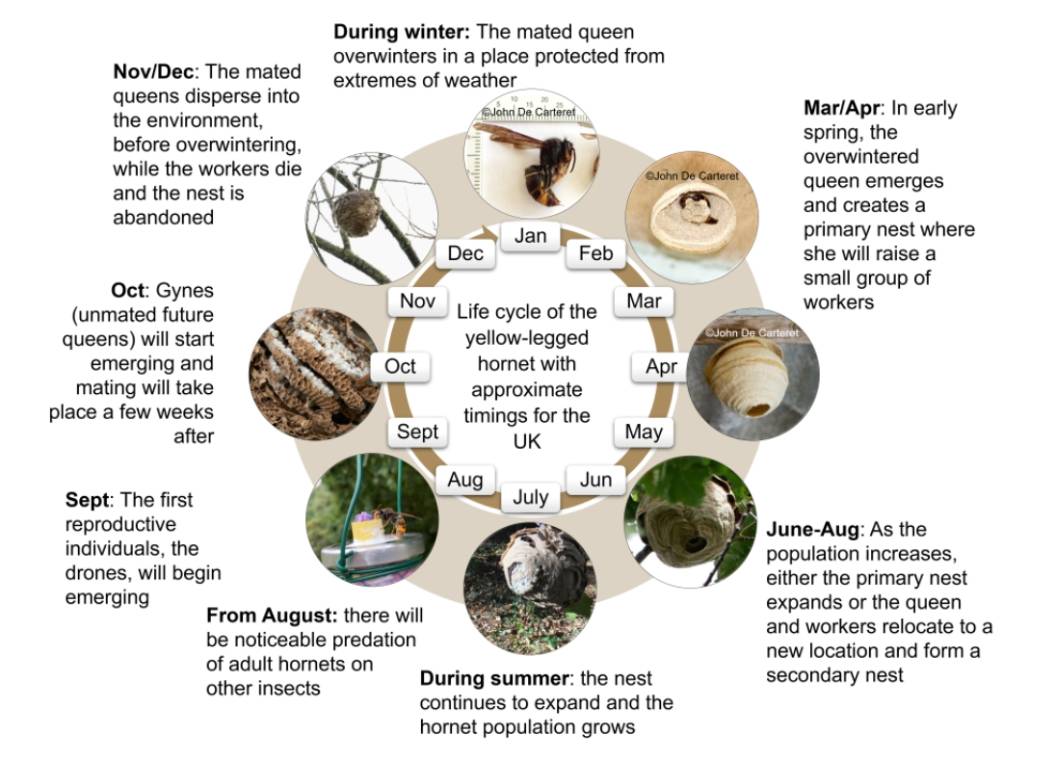
Life cycle of Yellow-Legged (Asian) Hornet
Nests
It is important not only to be able to recognise the Yellow-Legged (Asian) hornet, but also to be able to recognise the nests of the species. They start with a small Primary Nest, which looks very similar to a wasp nest and starts off about the size of a tennis ball and grows slightly throughout the spring/early summer. As the hornets outgrow this nest, they will go on to build large secondary nests. These can contain hundreds of Queen Hornets and thousands of worker hornets, therefore can be quite large in size and are very important to be destroyed before the queens hatch.
Hornets will make nest wherever they can, so please keep an eye in garages, sheds, wood stores and sides of building etc., as well as in trees, cliff faces and buildings. If you have seen or found something similar – please contact your local Hornet Action Team, which you can find details of here.
